Pest population explosion feared as council spending cuts bite
Experts are worried but Whitehall says it's not our problem
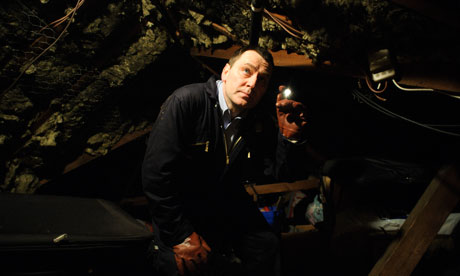 Pest controller Bob Howard checks the attic of a house for evidence of rat or squirrel infestation. Photograph: Frantzesco Kangaris
"If you leave your front door open, don't be surprised if there's someone sitting in your living room," sighs Bob Howard as he scans the walls of a house in commuter-belt Hertfordshire and tries to determine whether rats or squirrels are laying stealthy siege to its loft.
According to the veteran pest controller, rodents aren't the only creatures making themselves comfortable in our midst: pest populations, including bedbugs, appear to be on the rise across the county just as the money needed to tackle them dwindles. Budget cuts of almost 30% mean that local authorities no longer have the funds to deal with pests. As they have no statutory duty to provide such services, some have reduced their pest control teams and outsourced the work to private contractors; others have introduced charges, while some have ceased offering services altogether.
The Chartered Institute of Environmental Health has warned that the austerity cuts – exacerbated by poor housing standards, mild winters and lack of central government involvement – risk causing "a national pest explosion", which could pose a serious public health threat. The National Pest Technicians Association, which has more than 850 members, is also worried. Its most recent survey shows that only 70% of local authorities provided an in-house rodent control service in 2010-11, down from 80% two years earlier. The survey, completed by 243 of the UK's 398 local authorities, also reveals that more than 40% of councils charged for rat control in 2010-11, compared with around 30% on 2009-10.
The number of professional local authority pest treatments last year was barely half what it was in 2005-06, a decline far too large, according to the NPTA, to be attributed to a plunge in infestation levels. Bob Mayho, the CIEH's principal policy officer and chair of the National Pest Advisory Panel, said technicians, equipment manufacturers and pesticide suppliers were all reporting increased rat numbers and activity.
Like everyone else in the field, he is unable to give even a rough estimate of the rise. "Rats, by their nature, by and large, stay hidden," he said. The CIEH's worries about the effects of the cuts are twofold. Not only does the introduction of charges mean that people will be less able to pay for treatment in the poorer, inner-city areas which are more prone to infestations, but the contracting-out of services also makes it harder for local authorities to treat pest management as part of their wider public health strategy.
The institute wants the government to show it is serious about public health implications by ensuring a single department takes responsibility for matters split between the Department for Communities and Local Government, the Department for Environment, Food and Rural Affairs and the Department of Health. John Davison, chief executive of the NPTA, shares the CIEH's gloomy outlook. "We're on a bit of a downward spiral at the moment," he said. "It's not looking good on the rodent populations at all, and next year could see quite a large increase when, of course, the councils are going to be cutting back even more."
For Kevin Higgins, membership manager of the British Pest Control Association, the situation in 2012 is reminiscent of the 1980s, when councils were under similar pressure. "There are a lot of people who can't afford to pay for the services that are normally subsidised through their local authority, so those problems aren't being treated," he said.
Not everyone believes that the rat population is booming. Dr David Channon, director of Microbee, a London-based pest control firm, thinks rat numbers tend to be hugely overestimated and says he has seen no evidence in the sewers or above ground to suggest the population is on the rise. Still, he added, that doesn't mean there isn't a problem. "When you've got the situation where local authorities have kind of absolved themselves from responsibility for pest control, then who does stand up and shout when there's an issue, if not the chartered institute or the pest control companies?" he asked.
A spokesman for the Local Government Association said some local authorities were being forced to introduce "nominal charges" or restrict their subsidised services as the cuts started to bite. He added: "Councils have had their budgets cut by 28% and have little choice but to cut back on the non-statutory services they provide to ensure they can still do the most important things like caring for the elderly and protecting vulnerable children."
A government spokesman said: "It's up to local authorities to ensure adequate pest control in their neighbourhoods as they know best the problems they face, and there are no plans to change that. However, the government has launched a fund of up to a quarter of a billion pounds to help support councils to deliver better, more environmentally-friendly weekly bin collections for residents, which will help stamp out conditions that encourage pests to breed."
No one is quite sure what the wider implications of the cuts will be when it comes to rats and public health. Prof Robert Smith, a pest control expert and emeritus professor at the University of Huddersfield, said the reduction in local authority pest control provision "might be seen as an interesting – though unplanned – experiment in what happens when central and local government withdraw from providing health-related services that used to be taken for granted". "Unfortunately, I doubt whether there will be any attempt to collect data systemically on the consequences."
Bob Howard, who spent 17 years in the environmental health team at Ealing council in west London before taking out a franchise with a private pest control firm , suspects he knows how things will be in a decade's time. "Local authorities will be lucky if they've got any kind of in-house service; most of it will be outsourced and people like me will be thriving and trying to keep down the population that is inherently, year-on-year, growing," he said.
In the end, the culprits in the Hertfordshire house turn out to be squirrels rather than rats. Still, as Howard points out, the principle is the same whatever the pest: "These things have to be got rid of. Someone's got to do it, and if it's not the local authority, it's me."
According to the veteran pest controller, rodents aren't the only creatures making themselves comfortable in our midst: pest populations, including bedbugs, appear to be on the rise across the county just as the money needed to tackle them dwindles. Budget cuts of almost 30% mean that local authorities no longer have the funds to deal with pests. As they have no statutory duty to provide such services, some have reduced their pest control teams and outsourced the work to private contractors; others have introduced charges, while some have ceased offering services altogether.
The Chartered Institute of Environmental Health has warned that the austerity cuts – exacerbated by poor housing standards, mild winters and lack of central government involvement – risk causing "a national pest explosion", which could pose a serious public health threat. The National Pest Technicians Association, which has more than 850 members, is also worried. Its most recent survey shows that only 70% of local authorities provided an in-house rodent control service in 2010-11, down from 80% two years earlier. The survey, completed by 243 of the UK's 398 local authorities, also reveals that more than 40% of councils charged for rat control in 2010-11, compared with around 30% on 2009-10.
The number of professional local authority pest treatments last year was barely half what it was in 2005-06, a decline far too large, according to the NPTA, to be attributed to a plunge in infestation levels. Bob Mayho, the CIEH's principal policy officer and chair of the National Pest Advisory Panel, said technicians, equipment manufacturers and pesticide suppliers were all reporting increased rat numbers and activity.
Like everyone else in the field, he is unable to give even a rough estimate of the rise. "Rats, by their nature, by and large, stay hidden," he said. The CIEH's worries about the effects of the cuts are twofold. Not only does the introduction of charges mean that people will be less able to pay for treatment in the poorer, inner-city areas which are more prone to infestations, but the contracting-out of services also makes it harder for local authorities to treat pest management as part of their wider public health strategy.
The institute wants the government to show it is serious about public health implications by ensuring a single department takes responsibility for matters split between the Department for Communities and Local Government, the Department for Environment, Food and Rural Affairs and the Department of Health. John Davison, chief executive of the NPTA, shares the CIEH's gloomy outlook. "We're on a bit of a downward spiral at the moment," he said. "It's not looking good on the rodent populations at all, and next year could see quite a large increase when, of course, the councils are going to be cutting back even more."
For Kevin Higgins, membership manager of the British Pest Control Association, the situation in 2012 is reminiscent of the 1980s, when councils were under similar pressure. "There are a lot of people who can't afford to pay for the services that are normally subsidised through their local authority, so those problems aren't being treated," he said.
Not everyone believes that the rat population is booming. Dr David Channon, director of Microbee, a London-based pest control firm, thinks rat numbers tend to be hugely overestimated and says he has seen no evidence in the sewers or above ground to suggest the population is on the rise. Still, he added, that doesn't mean there isn't a problem. "When you've got the situation where local authorities have kind of absolved themselves from responsibility for pest control, then who does stand up and shout when there's an issue, if not the chartered institute or the pest control companies?" he asked.
A spokesman for the Local Government Association said some local authorities were being forced to introduce "nominal charges" or restrict their subsidised services as the cuts started to bite. He added: "Councils have had their budgets cut by 28% and have little choice but to cut back on the non-statutory services they provide to ensure they can still do the most important things like caring for the elderly and protecting vulnerable children."
A government spokesman said: "It's up to local authorities to ensure adequate pest control in their neighbourhoods as they know best the problems they face, and there are no plans to change that. However, the government has launched a fund of up to a quarter of a billion pounds to help support councils to deliver better, more environmentally-friendly weekly bin collections for residents, which will help stamp out conditions that encourage pests to breed."
No one is quite sure what the wider implications of the cuts will be when it comes to rats and public health. Prof Robert Smith, a pest control expert and emeritus professor at the University of Huddersfield, said the reduction in local authority pest control provision "might be seen as an interesting – though unplanned – experiment in what happens when central and local government withdraw from providing health-related services that used to be taken for granted". "Unfortunately, I doubt whether there will be any attempt to collect data systemically on the consequences."
Bob Howard, who spent 17 years in the environmental health team at Ealing council in west London before taking out a franchise with a private pest control firm , suspects he knows how things will be in a decade's time. "Local authorities will be lucky if they've got any kind of in-house service; most of it will be outsourced and people like me will be thriving and trying to keep down the population that is inherently, year-on-year, growing," he said.
In the end, the culprits in the Hertfordshire house turn out to be squirrels rather than rats. Still, as Howard points out, the principle is the same whatever the pest: "These things have to be got rid of. Someone's got to do it, and if it's not the local authority, it's me."

